
The 2026 M5 Hex Display
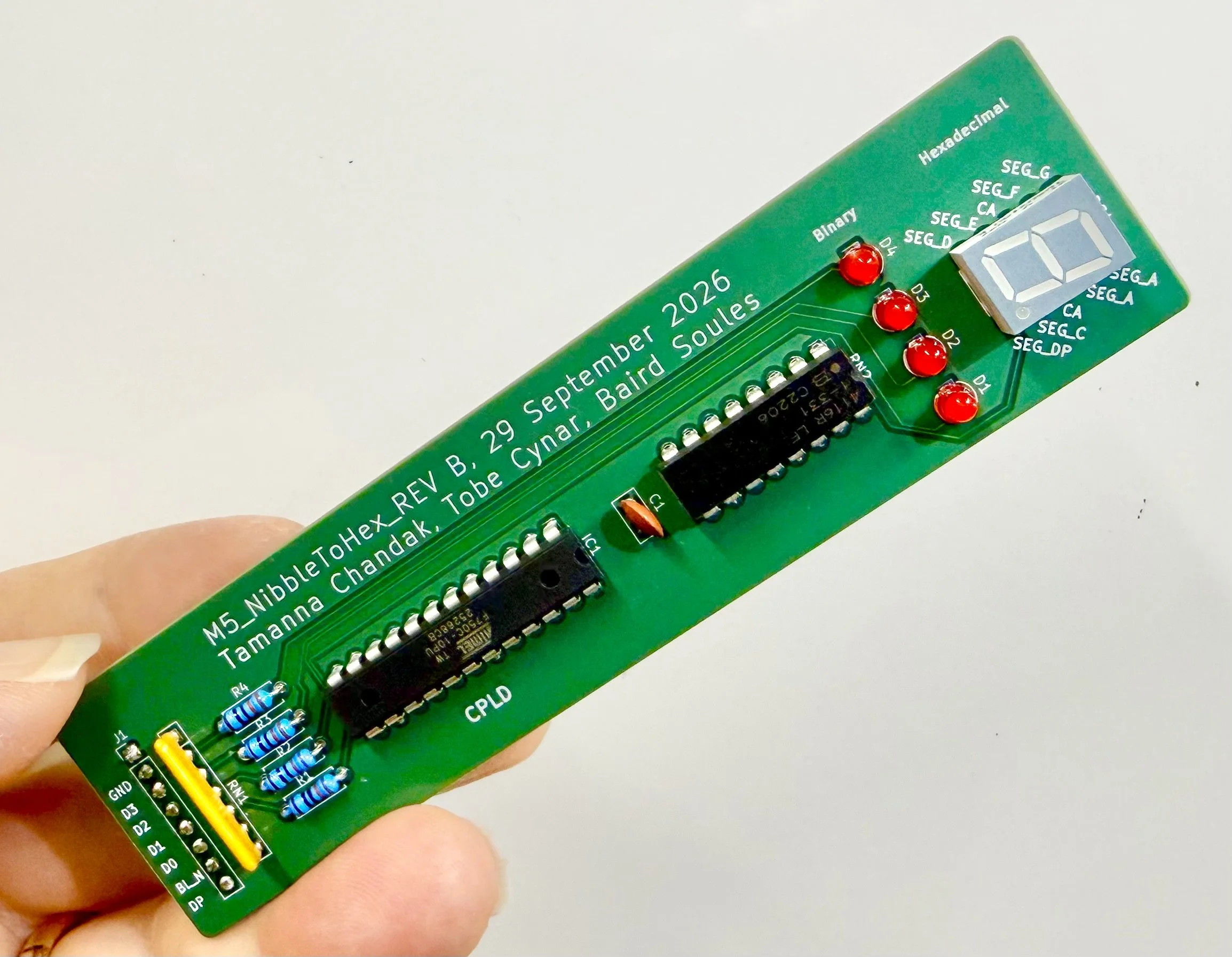
M5_NibbleToHex_REV B, 29 September 2026
The M5 Hex Display: A Breadboard-Friendly Hexadecimal Display for Teaching Digital Logic and Programmable Hardware
Tamanna Chandak, CompE '28, Tobe Cynar, EE '27 and Baird Soules have developed a small breadboard-friendly printed circuit board designed to make a nibble (a four-bit binary number) immediately visible to students of digital electronics, from middle school through college. The board accepts a four-bit binary input plus a decimal point signal, five volt power and ground, and displays the corresponding hexadecimal value — 0 1 2 3 4 5 6 7 8 9 A b C d E F — on a single seven-segment LED display. The board plugs into the top of a standard solderless breadboard. Along its lower edge are six 100 mil spaced header pins: bit 0, bit 1, bit 2, bit 3, decimal point, +5 V, and ground. Above the header pins is the pull-up resistor network and the CPLD IC (complex programmable logic device integrated circuit) that performs the decoding from four-bit input to seven-segment output. Above the CPDL is the current-limiting resistor network and the seven-segment display.
Unlike the BCD-to-seven-segment decoder chips used in many introductory electronics labs, this board displays the full hexadecimal range from 0 through F. This matters because students in computer engineering, embedded systems, digital logic, and retrocomputing encounter hexadecimal constantly, yet often lack a simple board that simply displays hexadecimal representation of a nibble (4 bits).
In live demonstrations, people may interact with the board in a couple of ways. First, they can manually drive the four data inputs using switches or jumper wires on a breadboard. As the input pattern changes, the four bit LEDs will show the binary value and the seven-segment display will show the corresponding hexadecimal character. Second, the board can be connected to a small four-bit up/down counter, allowing visitors to watch the display count from 0 to F and back again. The schematic and PCB layout were created in KiCad 10. The CPLD was programmed with Microchip’s WinCUPL II app (Windows-only, 2025).
The educational goal is to show how a student can move from a small conceptual need — “I want to see the value of these four bits” — to a finished custom PCB. The board connects binary representation, hexadecimal notation, seven-segment displays, programmable logic, PCB layout, breadboard prototyping, and the transition from abstract Boolean expressions to a working physical artifact.
The use of a CPLD is especially important. Many introductory digital electronics courses rely heavily on fixed-function logic chips, microcontrollers, or software simulation. CPLDs occupy a valuable middle ground: students can express logic directly, synthesize it into hardware, and observe the result without the conceptual overhead of a full FPGA workflow. The Boolean equations for the hexadecimal decoder can be inspected, modified, and reprogrammed, making the board a compact introduction to programmable logic.
This project is well suited to academic makerspaces because it is small, affordable, reproducible, and legible. It can be used as a teaching aid, lab component, debugging tool, outreach object, or KiCad design example. It also demonstrates a makerspace-centered approach to curriculum development: instead of relying only on commercial lab modules, students and instructors can design small custom boards that precisely match local teaching needs.
The contribution of this demonstration is not the invention of hexadecimal notation, seven-segment displays, or programmable logic. Rather, it is the integration of these familiar ideas into a small, teachable artifact. A four-bit hexadecimal display is a small object, but it addresses a real teaching need: helping students connect binary signals, physical circuits, and symbolic representation.
Code in our .pld file
Name bcd-hex;
Partno 001;
Date 06/16/2026;
Revision 01;
Designer Tamanna;
Company M5;
Assembly ;
Location Amherst;
Device V750C;
/* INPUTS */
PIN 2 = D; /* LSB (2^0) */
PIN 3 = C; /* (2^1) */
PIN 4 = B; /* (2^2) */
PIN 5 = A; /* MSB (2^3) */
PIN 6 = BLANK; /* 0 = blank display */
PIN 7 = DEC; /* 1 = decimal point displayed */
/* OUTPUTS */
PIN 21 = a;
PIN 20 = b;
PIN 19 = c;
PIN 18 = d;
PIN 17 = e;
PIN 16 = f;
PIN 15 = g;
PIN 14 = dp;
/* LOGICAL EXPRESSIONS */
/* segment equations are CA: active-low */
/* BLANK = 1 drives output high = segment OFF */
a = !BLANK # !( !C & !A
# !D & B
# C & B
# D & C & !A
# D & !C & !B
# !D & C & A);
b = !BLANK # !( !D & !C
# !C & !B
# !D & B & A
# !D & !B & !A
# D & !C & !A
# D & !B & A);
c = !BLANK # !( !D & !B
# !C & !B
# !D & C
# D & !C
# !C & A
# !B & A);
d = !BLANK # !( !D & !C & !A
# !D & !C & B
# C & B & !A
# C & !B & A
# !C & B & A
# D & !B & !A
# D & !C & !B);
e = !BLANK # !( D & C
# D & B
# D & !A
# B & !A
# !D & !C & !A);
f = !BLANK # !( !B & !A
# D & !C
# D & B
# !D & C & !B
# C & B & !A);
g = !BLANK # !( D & !C
# B & !A
# !C & B
# D & A
# !D & C & !B);
dp = !BLANK # !DEC;
Keywords
Academic makerspaces; digital logic; CPLD; KiCad; PCB design; seven-segment display; hexadecimal; breadboarding; computer engineering education; programmable logic.
