
The secret way to dial on rotary phones
Our phone system has changed dramatically over the last century. You can ask almost any middle-aged adult and they can tell you how to use a rotary phone. The unfortunate truth is that most people in our generation have never even seen a rotary phone, except maybe in a movie or show they watched. At this point, they represent a much older stage of the phone system we use today. Their obsolescence marked a technological shift in the phone system, a shift towards the digital age. The rotary phone's successor was the touch-tone phone, which uses a combination of two sinusoidal frequencies to signal each number you could press. The touch-tone phone was much more adapted for the digital future we were rapidly approaching, but the rotary phone has a charm that the touch-tone phone could never match…
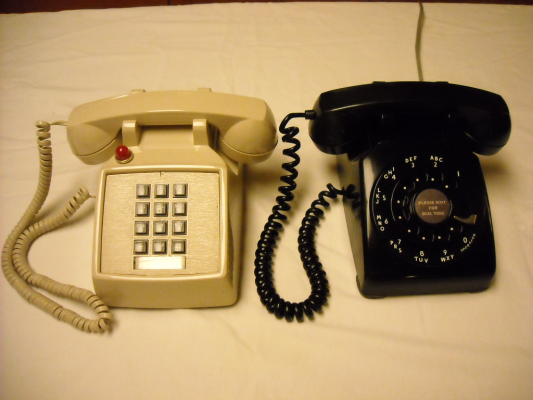
A touch-tone phone on the left, and a rotary phone on the right
So, if the touch-tone phone uses two sinusoids to signal each button press, how does the rotary phone work?
Pulse dialing
Pulse dialing actually hangs up the phone rapidly, and repeatedly hangs up corresponding to the digit dialed. For example, if you dialed a “2” on a rotary phone, it would hang up the phone twice in succession. If you’ve ever dialed on a rotary phone, you also know how slow the process can be. It can take up to 30 seconds to dial a number with a lot of zeros (since zeros are represented by 10 pulses) or higher number digits. This is one of the drawbacks of pulse dialing, but if you were a nerd back in the day, you knew of a “secret” way to dial much faster… The following graphic provides a visual representation for both pulse dialing and touch-tone phones:
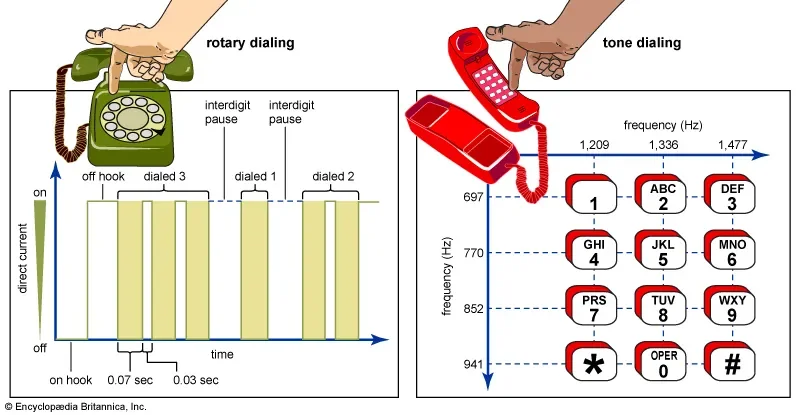
A visual representation of pulse dialing vs touch-tone dialing. On the left, “on hook” refers to the phone being hung up and resting on the base, and “off hook” refers to the phone being picked up and held off the base. On the right, the grid pattern refers to the combination of sinusoids to represent each number, e.g the number 1 is a 697Hz tone and a 1,209Hz tone together.
At this point you might be able to think of a “secret” way you can dial on rotary phones. If I wanted to dial a number, I just need to rapidly hang up the phone in the same way the phone would normally… So how does the phone know when its hung up?
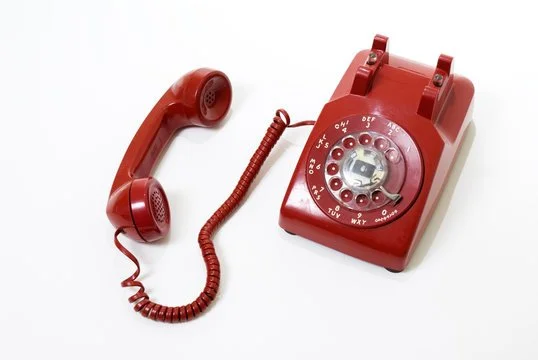
An “off hook” rotary phone.
See the two little clear pieces where the phone normally sits? Those are switches that are normally pressed when the phone is resting on the base. So if you want to dial without waiting for the rotary mechanism inside the phone to do it, all you have to do is press those clear pieces with the same sequential pulses! If you are really good at it, you can dial a number that would normally take 30 seconds to dial in under 15!
Ian Butler and I take advantage of this in our Telethon PBX Sniffer. Since the PBX supports pulse dialing, we use one relay to take control of the phone line, and the other to hang it up. This lets us dial any number we want without the need for synthesizing sinusoids or digital electronics.
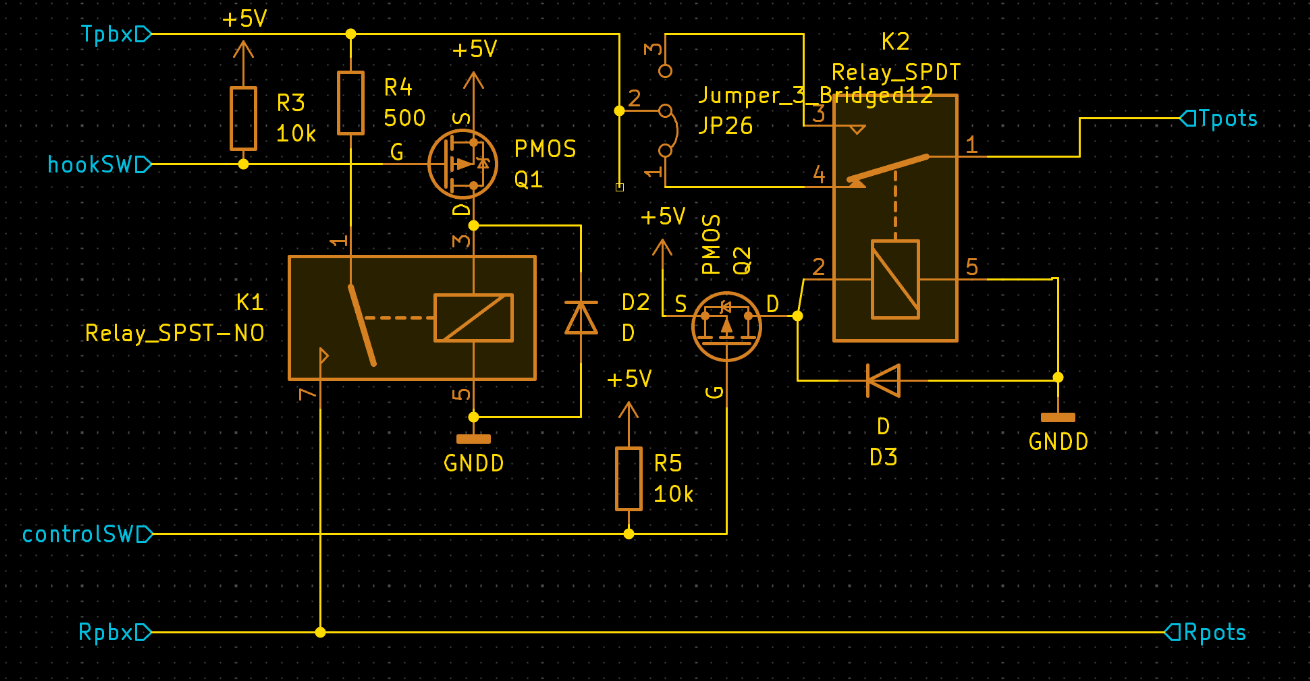
The dialing circuit used on the PBX Sniffer. “T” is for “tip” and “R” is for “ring” which refers to the tip and ring connector being used. The tip contains the main audio signal. “pbx" is the side connected to the PBX, and “pots” is the side connected to the phone we want to be able to dial on. When “controlSW” is low, we take control of the line and the phone signal is not able to pass through. Then, we can pull “hookSW” low to place the phone “on hook” (the phone system at the time expects a 500 ohm resistor between the tip and ring to signal “on hook”). Now, we can dial any number we want by pulling these lines high and low with something like a microcontroller.
If you stop by during the Telethon on Saturday, April 25th, come see if you can pull it off!
