
Let’s simulate Black Magic!
Better known as simulating electromagnetic transience, let’s make an antenna that receives frequencies so high that the VNAs at the antenna lab here wouldn’t even register!
A gross simplification of a Vector Network Analyzer, or VNA for short, is that it will send various frequencies of sine waves at one of its ports, and measure how much of the reflected sine wave comes back. If we’re making an antenna, we want the VNA to measure a return loss of 0 at our desired frequency, which the VNA will display as -60 dB or so, since it is on a logarithmic scale, and log(0) = -infinity.
An antenna guides electromagnetic waves that traverse around the universe into electronics for processing. The reason that we want a return loss of 0, is because we want all of the received electromagnetic wave from the antenna to make it to the device that is receiving it, and experience no reflected waves. Reflection indicates inefficiencies, since not all of the input power got consumed, but instead got sent back to the generator, in this case, an antenna. When there are tiny, tiny amounts of power receivable in the air, we don’t want any to go to waste!
Anyways, the problem with the VNAs on campus is that they are only good up to around 6 GHz. If I want to benchmark an antenna used for frequencies beyond that, I’d need to spend a lot of money on a VNA of my own that can test those frequencies. Even though I don’t have a fancy VNA, I’m going to still make a ~40 GHz antenna for fun.
To do this, I’m going to design a patch antenna in KiCAD (printed circuit board design software), and then use a program called gerber2ems to port the KiCAD fabrication outputs to openEMS, which will do the electromagnetic simulation.
To design the antenna, I used the design equations in former UMass Professor David Pozar’s Microwave Engineering 4th textbook, which was the basis for my ECE 584 Microwave Engineering class. The math involved uses formulas that are empirically derived, also known as the “just trust me bro” formulas where they get you the correct results, even though it is not mathematically derived or make any sense.

Such an example, length of a microstrip patch antenna…
Anyways, this is where I cast my magic spell, and give creation to an antenna design that I want.
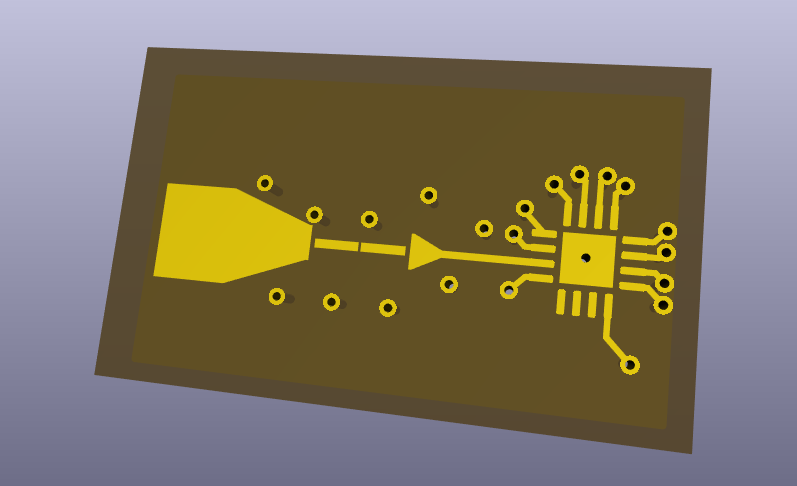
Check out this thing! It looks huge, but in reality, this whole board is only around 0.8 inches long, and would easily fit in the palm of your hand. Anyways, the larger section off to the left is the actual antenna part, which is magically the right size to trap 40 GHz waves. Then, there is a linear taper to match to a 50 ohm transmission line, which then immediately goes into a band-pass filter with around a ~3 GHz bandwidth. This is where microwave engineering really shines through. Normally we think of these filters as resistors and capacitors, or op-amps if you are fancy. The thing is… these are exactly resistors and capacitors! The gaps in the transmission line act as series capacitors that let high frequency through, and then the dimensions of them are picked out to create a shunt admittance to the ground plane to waste the super high frequencies that we don’t want. Finally, the 50 ohm line is once again tapered to fit the MACOM RF detector that will be placed to detect if there is a great presence of 40 GHz waves in the area. The random ground vias you see placed around also help with the transmission line efficiency.
Let’s see how I did by running this board in the sim!
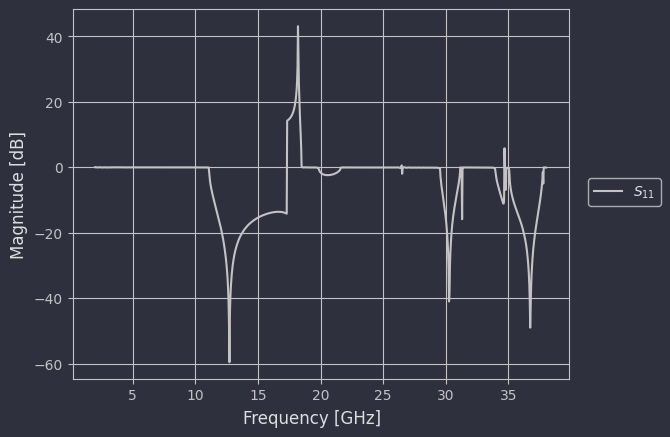
Hey, apart from the random spike at around 18 GHz that is likely due to the simulation not converging at those frequencies, I kinda see what I expect! (The dips in magnitude indicate the frequencies in which our measured port are best at receiving.) Although, I see two more resonant modes than I would have liked. Looking at the electric fields in the simulation animation explains one of the other resonant modes…
Oops! Looks like the random routing of ground vias around the detector, and lack of ground pour on the front turned the RF detector’s footprint into an antenna! This is RF engineering at its finest, where everything is an antenna, and nothing makes sense. Pretty cool right?
