
Humidity…. Friend or Foe?
Recently, someone in M5 made a handy humidity sensor for their room. This device would display a message when their room was too dry, as an indicator to check up on their humidifier’s tank. While discussing this project, it was pointed out that M5 is constantly around 15% humidity! While this low humidity makes sense at first glace, given that electronics often don’t play nicely with water, it’s actually missing the bigger picture.
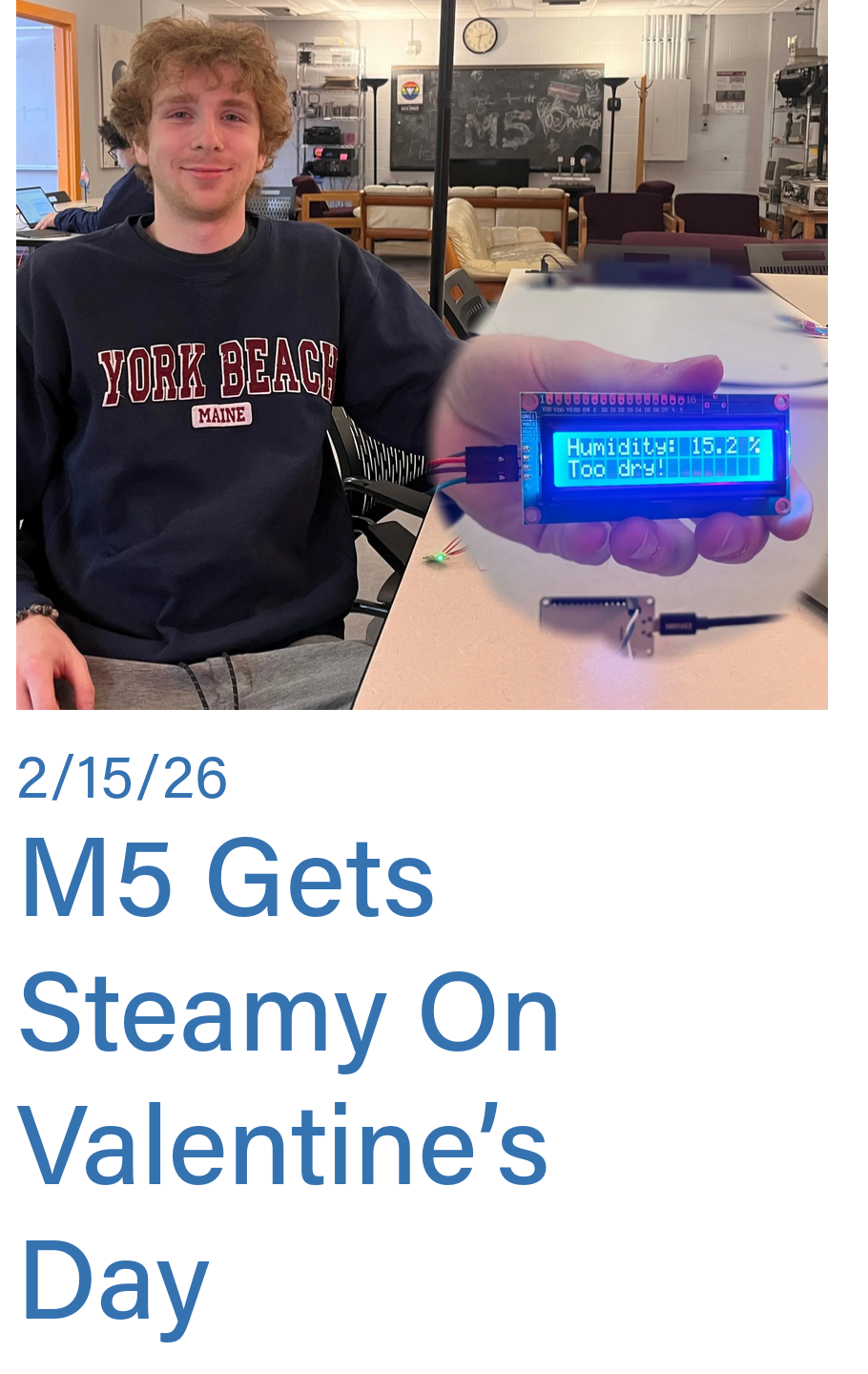
An Absolute brilliant must read by Jenny Tang, check it out here! https://www.umassamherstm5.org/blog/m5-gets-steamy-on-valentines-day
For a recap of how humidity works, water vapor is generally always dissolved in the air around us. Relative humidity is a way to account for how much water vapor is dissolved in the air. As temperature increases, the molecules in the air have more kinetic energy to vaporize water, which allows for more water vapor to be held in the air. As temperatures cool, the air around us have less kinetic energy, which causes less water to be able to be evaporated. This means that a 100% relative humidity at 20 degrees Fahrenheit is not the same as 50 degrees Fahrenheit.
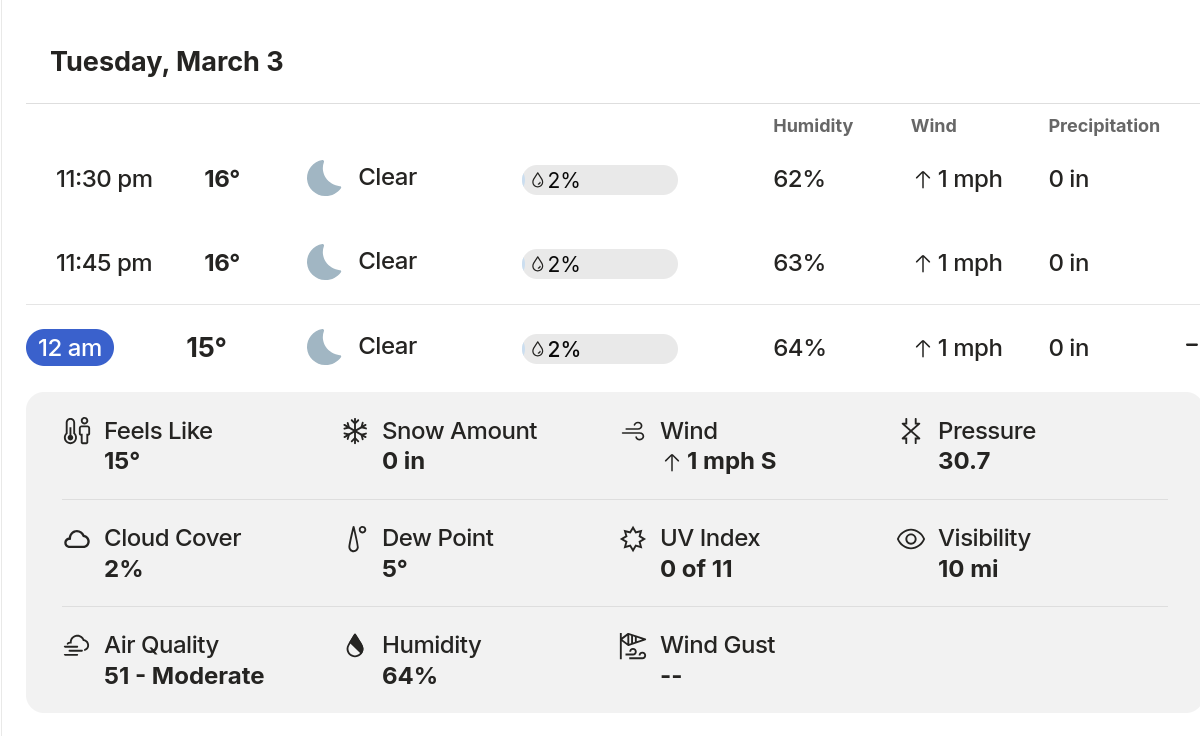
A picture of the current humidity report for Hadley MA. Despite my lips needing chap-stick, the relative humidity is actually 62%, because the weather is so cold that only a little bit of water can actually exist as water vapor. if we were to heat this atmosphere to 70 degrees Fahrenheit, the relative humidity would drop to 10-15%.
When Water’s Dangerous
Water is often dangerous when it has dissolved ions and it comes into contact with your electronics. Water almost always has dissolved ions, except when it’s distilled. This actually plays a key role in your body, as the dissolved ions ensure that minerals and vitamins in your body don’t leach into the water you drink. This allows for humans to retain the minerals we absorb from food, instead of it getting instantly dissolved in the water we drink.
However, when water with dissolved ions comes into contact with electronics, the ions will become mobile charge carriers, and bridge different potential energies, causing short circuits across your board.
This is generally only a concern if you have issues with condensation (say an electronic device operating in a colder region that’s exposed to warmer air), or if you dunked your electronics in a lake.
Water could be a friend?!

While having too much water in the atmosphere is certainly dangerous for our electronics, having too little starts causing problems too. The biggest issue is letting static electricity build up.
When we have a decent humidity level, the water vapor must constantly evaporate and condense to maintain an equilibrium. This will cause water to circulate around our environment, and with it’s charged ions, dissipate any static electricity in our area. Imagine the water as a thin conductive layer that moves throughout different surfaces in an area. This allows for electronics and humans to not build up voltages from static electricity.
Ways to deal with ESD
There are many ways to deal with ESD, and it’s generally a solved problem. Besides making sure your working environment is at a relative humidity of 30-60%, touching something grounded before touching any delicate circuitry is often good advice. In a pinch, you can also wash your hands, which will allow the water to conduct your static potential away to ground. You can also wear ESD bracelets, which M5 has available, in the Pi room!
Niranjan Mathirajan
Electrical Engineering, 2027
2 March 2026